
Many English learners often confuse Their vs There vs They’re because these words sound exactly the same when spoken. However, their meanings and uses in sentences are completely different.
Understanding the difference between their vs there vs they’re is important for writing correct English. Using the wrong word can change the meaning of your sentence and make your writing look unprofessional.
In this grammar guide, you will learn the correct meaning of their, there, and they’re, along with simple examples that make these words easy to understand.
Their vs There vs They’re Full Explained
What Does “Their” Mean?
The word their is a possessive adjective. It shows that something belongs to them.
In simple words:
Their = ownership
Examples
- The students forgot their books.
- Sarah and Tom brought their laptops.
- The children are playing with their toys.
In these sentences, their shows possession.
What Does “There” Mean?
The word there is used to refer to a place or location. It can also be used to introduce a sentence. Their vs There vs They’re – Easy Grammar Guide
Examples
- The restaurant is over there.
- Please put the bag there on the table.
- There are many books in the library.
In these examples, there refers to a location or place.
What Does “They’re” Mean?
The word they’re is a contraction of they are.
Whenever you can replace the word with they are, then they’re is correct.
Examples
- They’re going to the park. Their vs There vs They’re – Easy Grammar Guide
- They’re studying English grammar.
- I think they’re ready for the exam.
If you replace the word:
They are going to the park ✔
They are studying English ✔
So they’re = they are.
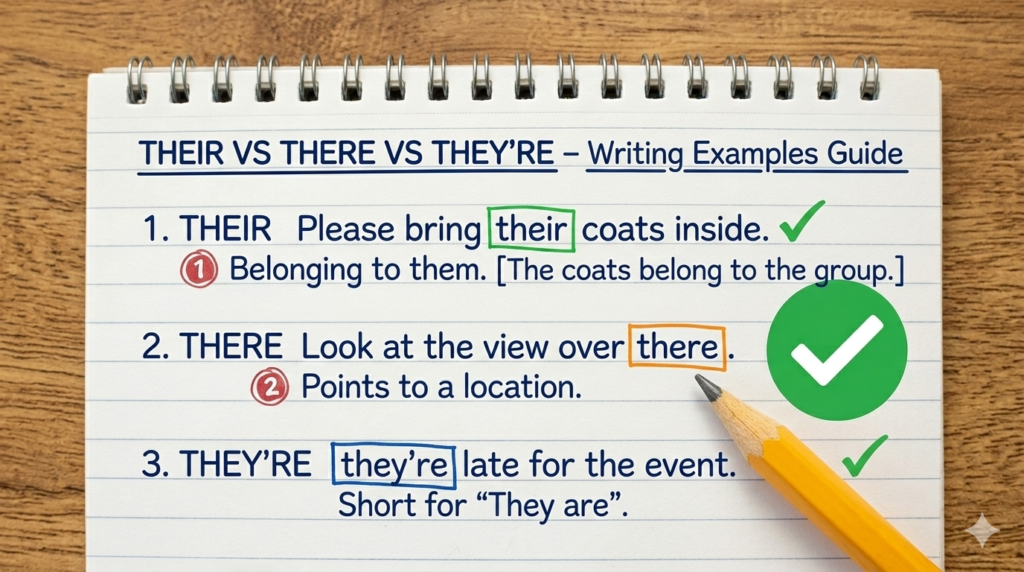
Simple Trick to Remember, Their vs There vs They’re
Here is an easy way to remember the difference:
Their → Ownership
There → Place
They’re → They Are
Example:
- Their house is beautiful.
- The car is parked over there.
- They’re coming to the party tonight.
Quick Comparison Table
| Word | Meaning | Example |
|---|---|---|
| Their | Ownership | Their car is new |
| There | Place | The keys are over there |
| They’re | They are | They’re happy today |
FAQ Section
Many learners struggle with their, there, and they’re because they sound the same in spoken English. These commonly confused words are known as homophones, and learning their meanings can improve your writing skills.
Frequently Asked Questions (FAQ)
What is the difference between their, there, and they’re?
Their shows possession, there refers to a place, and they’re is a contraction of they are.
Why do people confuse these words?
People confuse them because they sound exactly the same when spoken, even though they have different meanings.
Is “their going to school” correct?
No. The correct sentence is:
They’re going to school.
How can I remember the difference easily?
Use this trick:
Their = belongs to them
There = place
They’re = they are
Related Posts
You may also like these articles:
- Affect vs Effect – What Is the Correct Difference?
- Then vs Than – Grammar Rule Explained
- Your vs You’re – Easy Grammar Guide
- Who vs Whom – Simple Grammar Explanation
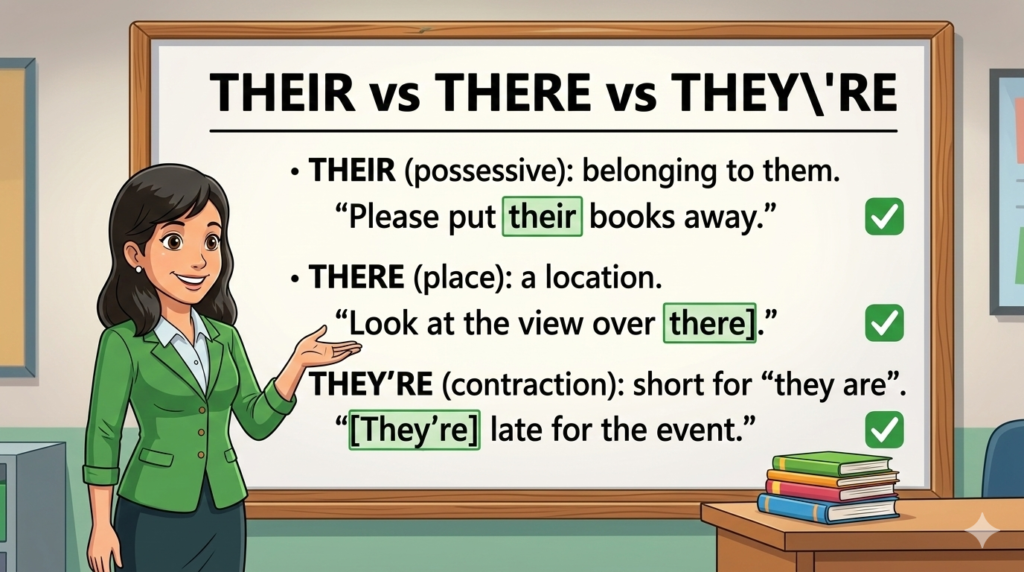
Comparison Table: At a Glance
| Word | Part of Speech | Meaning | The “Test” |
| Their | Possessive Adjective | Belonging to them | Replace with “Our” — does it work? |
| There | Adverb / Pronoun | A place or existence | Replace with “Here” — does it work? |
| They’re | Contraction | They are | Replace with “They are” — does it work? |
Putting It All Together: The Master Sentence
To truly master these homophones, try to memorize this sentence, which uses all three correctly in one go:
“They’re (They are) putting their (ownership) bags over there (place).”
The Golden Rule of Proofreading
Errors with these words often happen because our brains move faster than our fingers. When proofreading, read your work out loud. When you hit one of these words, pause. Check for the “Heir” (ownership), the “Here” (place), or the “Apostrophe” (They are). Their vs There vs They’re – Easy Grammar Guide
By taking an extra two seconds to verify your choice, you ensure your writing remains sharp, professional, and clear.

William Henry is a writer for Grammar Max, a blog that focuses on synonyms and phrases. He loves exploring the quirks of the English language and enjoys helping readers improve their vocabulary. William’s articles are easy to read, fun, and full of useful tips for anyone looking to better understand and use English. Whether you’re a student, a professional, or just someone interested in language, William’s writing on Grammar Max makes learning about words and their meanings simple and enjoyable.