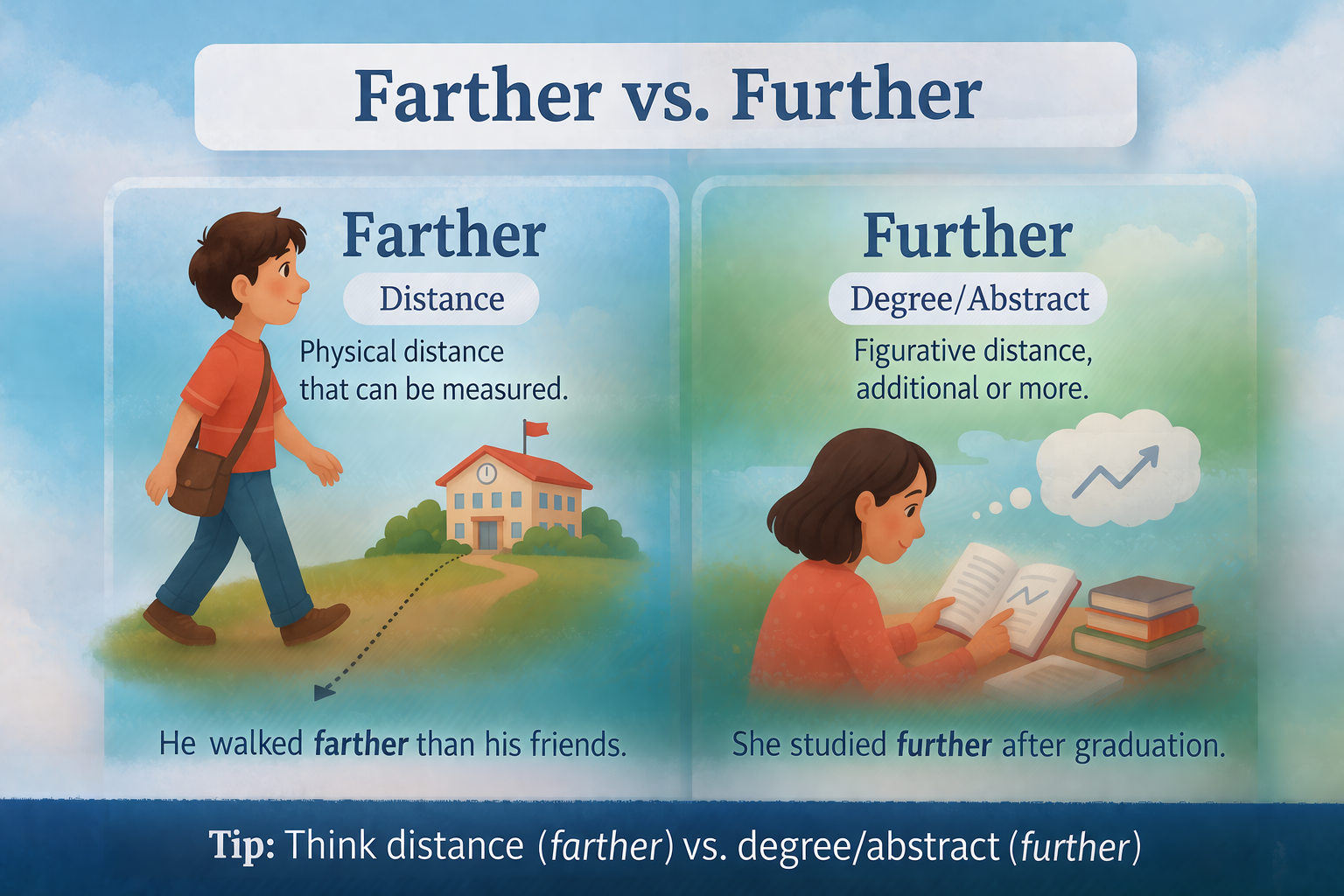
Learn the difference between farther vs further with simple examples. Understand distance vs figurative meaning and improve your English grammar
Many English learners get confused between farther and further because both words are related to distance. However, they are used in slightly different contexts.
Understanding the difference between farther vs further will help you write more clearly and professionally. In this guide, we will explain both words in a simple way with easy examples.
What Does “Farther” Mean?
The word farther is used to talk about physical distance. It refers to something that can be measured in space.
Examples of Farther
- He ran farther than me. Farther vs Further
- The school is farther down the road.
- Can you walk farther than 5 kilometers?
- She moved farther away from the city.
👉 Use farther when talking about real, measurable distance.
What Does “Further” Mean?
The word further is used for figurative or abstract distance. It can also mean additional or more.
Examples of Further
- We need to discuss this further.
- She continued her studies further.
- For further information, contact us.
- Let’s move further into the topic.
👉 Use further for ideas, time, or degree, not physical distance. Farther vs Further
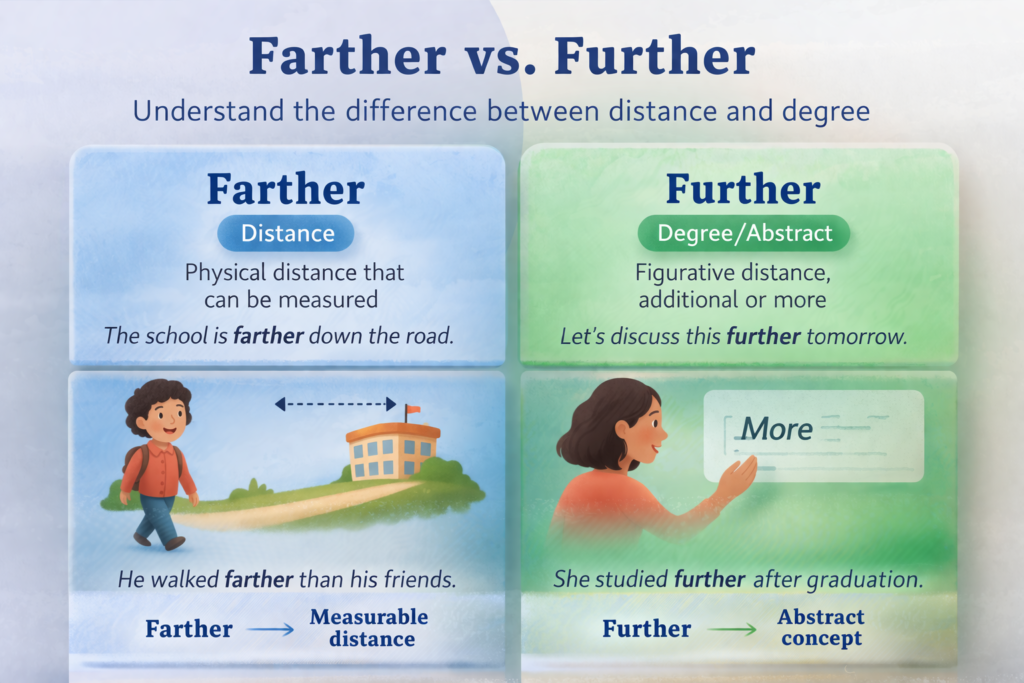
Key Difference Between Farther and Further
| Word | Meaning | Usage | Example |
|---|---|---|---|
| Farther | Physical distance | Measurable space | He ran farther |
| Further | Figurative/abstract | Ideas, time, degree | We will discuss further |
Can Farther and Further Be Used Interchangeably?
In modern English, especially in casual writing, people sometimes use further for both meanings. However, in formal writing, it’s better to follow the correct rule:
- Farther → physical distance
- Further → abstract ideas
Simple Trick to Remember. Farther vs Further
Here is an easy trick:
👉 Farther = Far (distance)
👉 Further = Figurative / Future / More
This trick helps you quickly decide which word to use.
Common Mistakes People Make
❌ Incorrect:
We need to walk further down the road.
✅ Correct:
We need to walk farther down the road. Farther vs Further
Another example:
❌ Incorrect:
Let’s discuss this farther.
✅ Correct:
Let’s discuss this further.
Why This Grammar Rule Is Important
Learning the difference between farther vs further helps you:
- Write more accurately
- Improve clarity in communication
- Avoid common grammar mistakes
- Sound more professional in writing. Farther vs Further
Even though the difference is small, it can make your writing more precise.
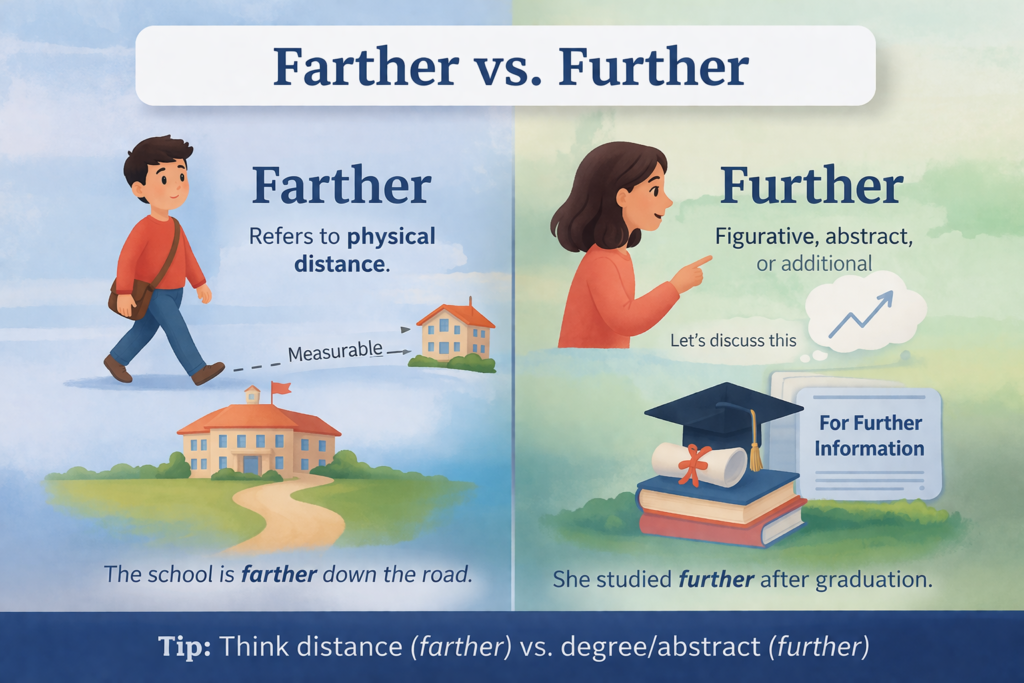
Extra Tip for Better Understanding
In formal English, especially in academic or business writing, using the correct word shows attention to detail. Native speakers may sometimes mix them up, but using them correctly can give you an advantage.
When in doubt, remember that “farther” deals with distance you can measure, while “further” deals with ideas or additional information.
FAQ Section
Frequently Asked Questions
What is the difference between farther and further?
Farther is used for physical distance, while further is used for abstract or figurative meaning.
Can I use further for distance?
Yes, in informal English, but in formal writing, it is better to use farther. Farther vs Further
Which word is more common?
Further is more commonly used in modern English.
How can I remember farther vs further?
Use this trick:
Farther = distance
Further = more or additional
Final Writing Tip for Farther vs Further
When writing in English, always think about whether you are talking about a real distance or an idea. If you can measure it in meters, miles, or steps, then farther is the correct choice. If you are talking about something abstract like discussions, progress, or information, then further is the better option. Building this small habit will improve your grammar accuracy and make your writing clearer, more professional, and easier for readers to understand. Farther vs Further
Related Posts
- Its vs It’s – Simple Grammar Rule Most Writers Get Wrong
- Who vs Whom – The Easy Rule Anyone Can Understand
- Lay vs Lie – Why This Grammar Rule Confuses Everyone
- Fewer vs Less – Grammar Rule Explained

William Henry is a writer for Grammar Max, a blog that focuses on synonyms and phrases. He loves exploring the quirks of the English language and enjoys helping readers improve their vocabulary. William’s articles are easy to read, fun, and full of useful tips for anyone looking to better understand and use English. Whether you’re a student, a professional, or just someone interested in language, William’s writing on Grammar Max makes learning about words and their meanings simple and enjoyable.