Many English learners often confuse “your” and “you’re.” These two words sound the same when spoken, but Your vs You’re have completely different meanings and uses in writing. Because of this, many people make mistakes when typing messages, emails, or assignments.
In this guide, we will explain the difference between “your” and “you’re,” their meanings, examples, and simple tips to help you remember the correct usage.
What Does “Your” Mean?
The word “your” is a possessive adjective. It is used to show that something belongs to you
In simple words, “your” means something that belongs to the person you are talking to.
Examples of “Your”
- Is this your book?
- I like your idea.
- Please bring your laptop tomorrow.
- What is your name?
In all these sentences, “your” shows ownership.
What Does “You’re” Mean?
The word “you’re” is a contraction. It is the short form of “you are.”
So whenever you write “you’re,” it actually means “you are.”
Examples of “You’re”
- You’re very kind.
- I think you’re right.
- You’re going to love this movie.
- If you’re ready, we can start.
If you replace “you’re” with “you are,” the sentence still makes sense.
Example:
You’re smart → You are smart
The Main Difference Between Your vs You’re
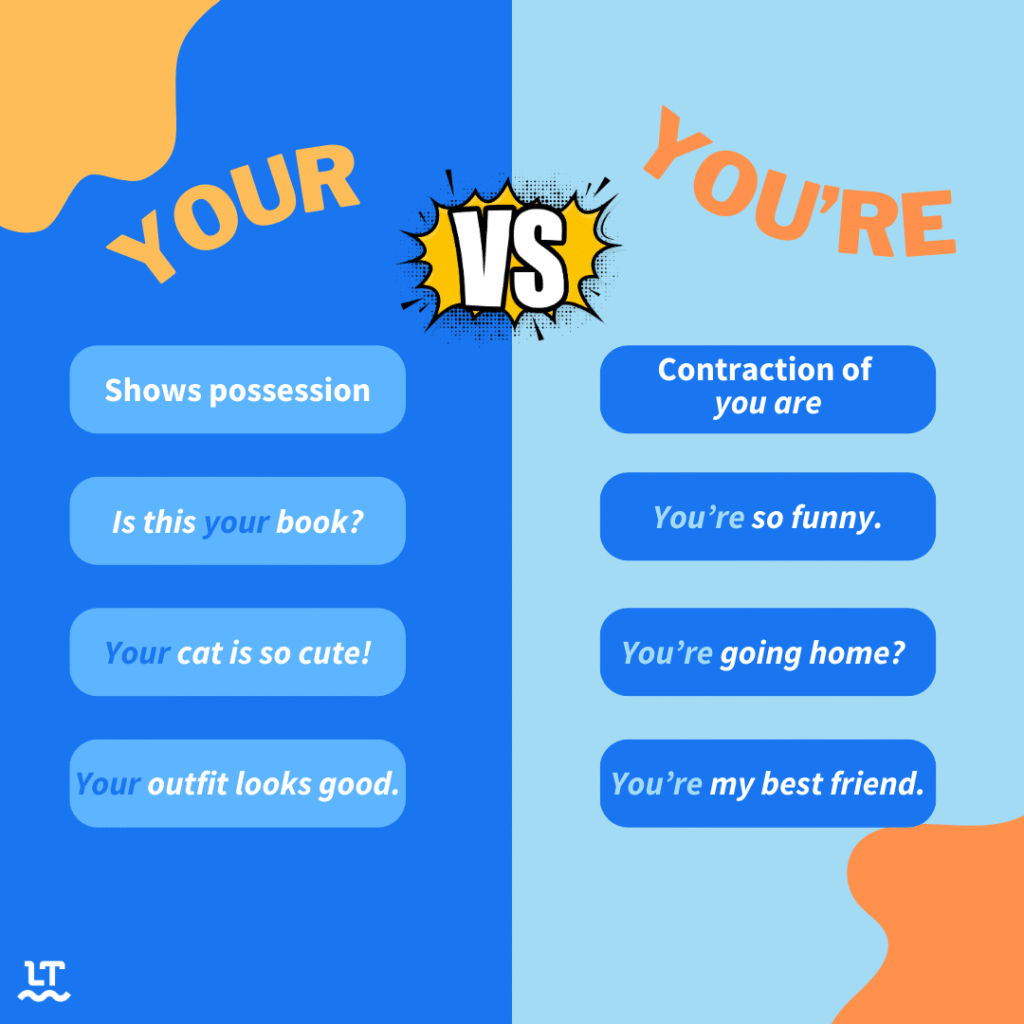
Here is a simple comparison: Your vs You’re
| Word | Meaning | Example |
|---|---|---|
| Your | Shows ownership | Your phone is ringing |
| You’re | Short form of “You are” | You’re very helpful |
So remember:
- Your = possession
- You’re = you are
Common Mistakes People Make Your vs You’re
Many people accidentally mix these words because they sound the same. This type of word is called a homophone. Your vs You’re
Incorrect Sentences
❌ Your going to be late.
❌ I like you’re new car.
Correct Sentences
✅ You’re going to be late.
✅ I like your new car.
Even native English speakers sometimes make this mistake when typing quickly.
Simple Trick to Remember the Difference
A very easy trick is to replace “you’re” with “you are.”
If the sentence still sounds correct, then “you’re” is the right word. Your vs You’re
Example
Sentence: You’re my best friend.
Replace it:
You are my best friend. ✔ Correct
But if you try the same with your:
Your my best friend → Your my best friend ❌ Incorrect
So the correct sentence is:
You’re my best friend.
More Examples for Practice Your vs You’re
Here are some extra examples to help you understand better. Your vs You’re
Using “Your”
- Where is your house?
- I like your style.
- Don’t forget your homework.
- Is that your phone?
Using “You’re”
- You’re doing a great job.
- You’re very talented.
- I think you’re ready for the test.
- You’re going to succeed.
Practicing these examples will help you avoid mistakes in your writing.
Why This Mistake Is Important to Avoid
Using it incorrectly can make your writing look unprofessional. This is especially important in:
- School assignments
- Business emails
- Job applications
- Blog posts
- Social media writing
Even a small grammar mistake can change how people see your writing skills. Your vs You’re
Related Grammar Articles
You may also like these helpful guides:
- Alot vs A Lot – Which One Is Correct?
- Their vs There vs They’re – Easy Explanation
- Then vs Than – Common English Mistake
- Lose vs Loose – Correct Spelling Guide
Reading these articles will help you improve your English grammar step by step.
Conclusion
To summarize:
- Your shows possession.
- You’re means “you are.”
Quick reminder:
- Your book is on the table.
- You’re a great student.
If you remember this simple rule, you will never confuse your and you’re again.
Practice using these words in sentences, and soon it will become natural in your everyday writing.
1️⃣ Alot vs A Lot – Which One Is Correct?
Example in your article:
You may also read:
👉 Alot vs A Lot – Which One Is Correct? Follow
Many English learners also confuse “alot” and “a lot.” You can read our detailed guide here: Alot vs A Lot – Which One Is Correct?

William Henry is a writer for Grammar Max, a blog that focuses on synonyms and phrases. He loves exploring the quirks of the English language and enjoys helping readers improve their vocabulary. William’s articles are easy to read, fun, and full of useful tips for anyone looking to better understand and use English. Whether you’re a student, a professional, or just someone interested in language, William’s writing on Grammar Max makes learning about words and their meanings simple and enjoyable.